Procurement User
Evaluate offers
Weight the criteria, score independently and document the decision so it can be followed later.
- Duration: 25 min
- Level: In depth
- Read first: Run the question round
Evaluation is the step where anything vague in the tender comes back at you. It is also the step an audit looks at first.
Offer evaluation is a paid extension. If the functions below are missing for you, that is why — not a setting.
Criteria and weighting
Criteria carry a weighting in per cent. The available types are number, price, free text and picklist.
For price there are two formulas: linear and degressive, with a cutoff at 20 per cent. That is considerably more than “cheapest wins”, and it is worth running both against old figures once before committing to one.
You can keep several named evaluation strategies; two standard ones are created automatically.
Everyone scores on their own
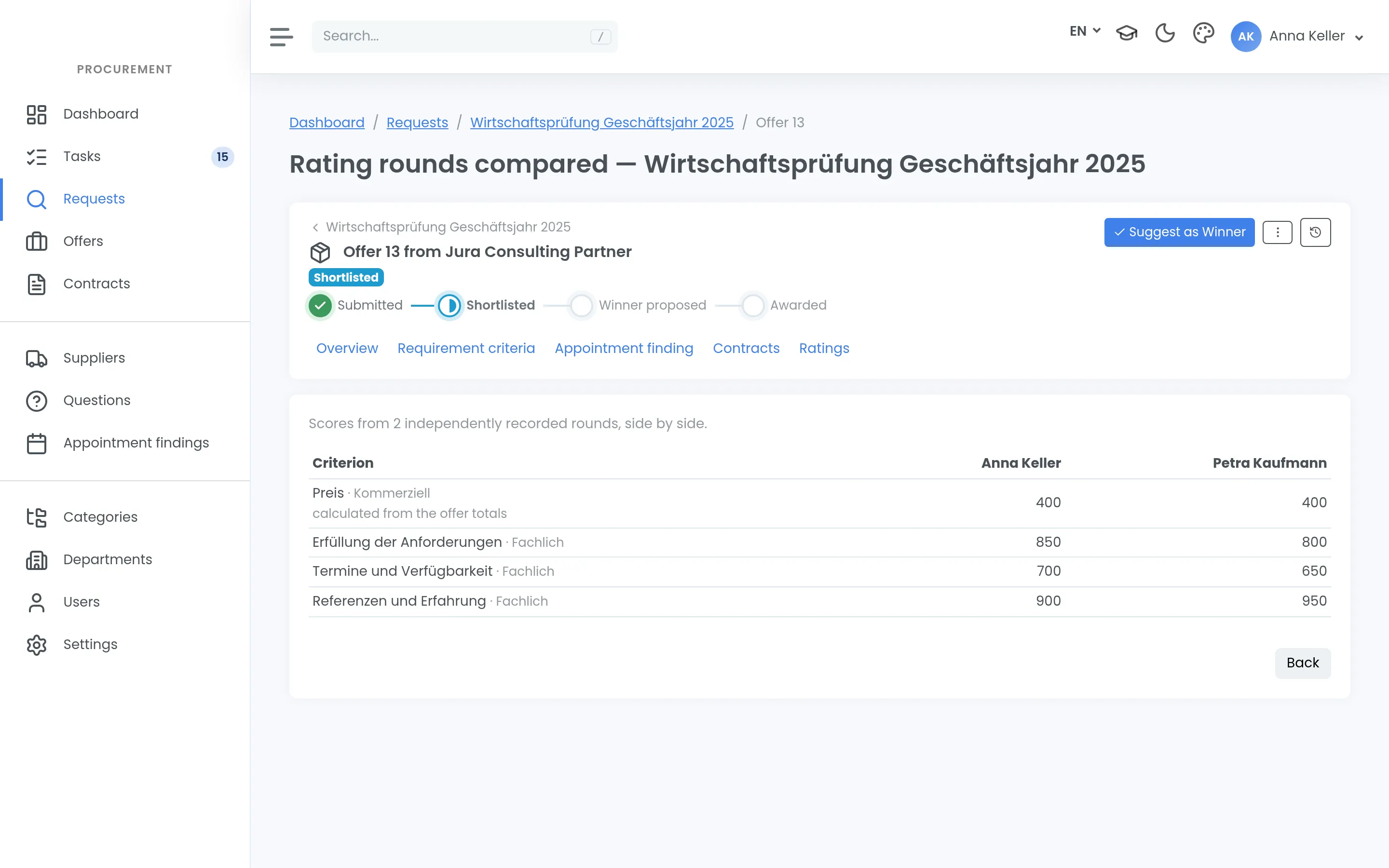
This is the function nobody expects: there are evaluation rounds per person. Several people score independently, and a comparison view follows.
The difference from a spreadsheet on a shared drive is not convenience — it is that nobody sees anyone else’s score before submitting their own. The discussion happens afterwards, about the differences, rather than about who saved last.
Deciding
Shortlist, winner proposal, confirmation, withdrawal: four steps, and the split between proposal and confirmation is the four-eyes principle. Withdrawal is provided for, and documented.
Internal notes on offers stay internal. The supplier never sees them — anything meant for them goes out as a message or as a stated reason.
Not every evaluation ends with a winner. If you close without an award, every participant receives an email.
If a procedure has to end early — the need has gone, the documents were wrong — withdraw the tender. That is possible at any time after publication, including after the offer deadline, and only for procurement. You record the reason internally; suppliers are not told it, but they receive an email straight away. The step cannot be undone, draft offers that were never submitted are deleted, and starting again means copying the tender.
Every closed tender then shows its outcome: closed with award, closed without award, or cancelled.
What does not exist
- No side-by-side scenario view. Several weighting models are possible; comparing them in one picture is not.
- No savings calculation. The dashboard tiles count; they do not compute.
- No case file across several rejection rounds on the supplier side: the latest round’s reason is documented, the history behind it is not. And a supplier never sees who rejected.
Where you save yourself work
Fix the criteria before publication and write them into the tender. Criteria that appear during comparison are hard to justify — and justification is exactly what an unsuccessful bidder asks for.