Procurement Admin · Procurement User · Department User
An overview of e-Request
What the platform is for, who works in it, and how a procurement runs from request to contract.
- Duration: 10 min
- Level: Getting started
- No prerequisites
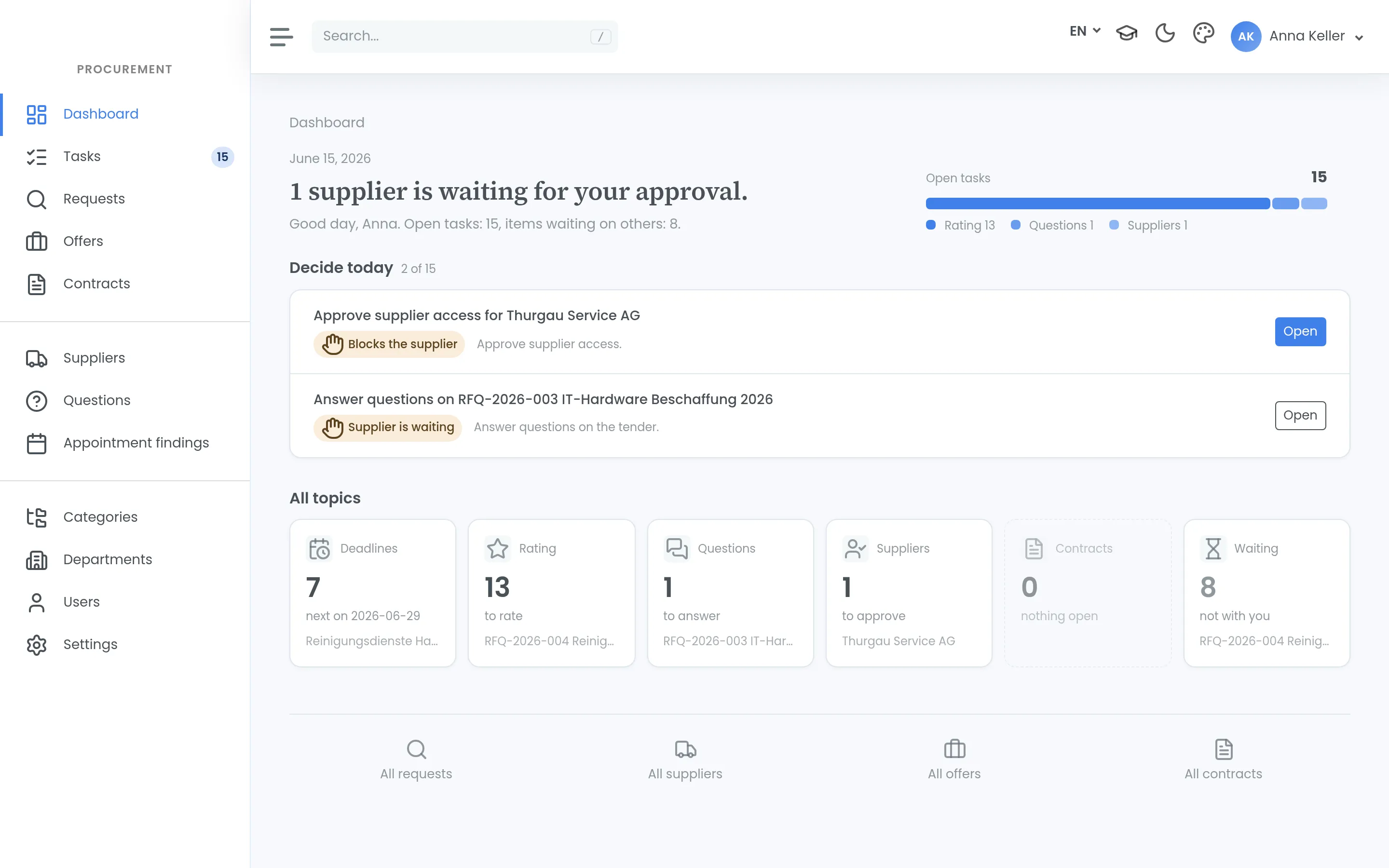
Before you configure or enter anything, it is worth looking at the process as a whole.
Who is involved
- Department raises a need and follows it.
- Procurement runs the purchase: tender, question round, evaluation, award.
- Admin sets up the organisation, manages roles and access, and maintains categories, criteria and templates.
- Suppliers work in a portal of their own — they never see your internal view.
These three roles exist in the product exactly as listed. They are not a suggested org chart; they are the permission model.
The process
- A need arises in a department.
- A tender is created, with documents, and approved internally.
- Suppliers are invited — procurement invites, there is no open self-registration.
- Question round: questions are collected, answered, approved and published to all invitees together.
- Offers are created and submitted in the supplier portal.
- Evaluation against criteria weighted in advance.
- Award and, where the contract module is in use, the contract.
The process is fixed on purpose
This is where e-Request differs from a toolkit: the steps are hard-wired. You cannot rearrange them, and that is the intent — a procedure that runs the same way every time is exactly what an audit can follow two years later.
What you can adapt is roles, rights, fields, criteria and templates. Not what happens in which order.
Anyone expecting to bend the process around an existing special case should know that early, which is why it is here and not in a footnote.
What is logged
Activity is logged comprehensively across the business objects, and every tender has its own log view. That is the second reason the fixed process pays: traceability comes from the software rather than from discipline.
What to read next
Depending on your role: as an admin, start by setting up the organisation. As procurement, start at the tender. As a department, the path from raising a need to tracking it is enough.